UA201115 - Woodward U-Joint UJT .750-20 (201) x 17,5 mm-54 (115)
Artikelnummer: UA201115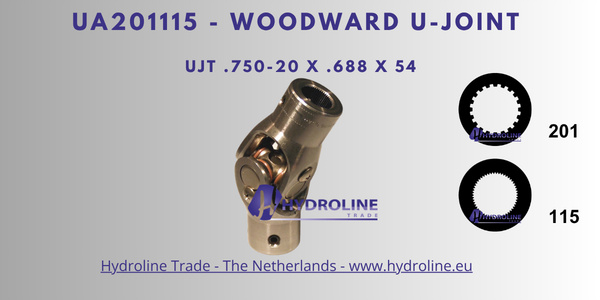
UA201115 - Woodward U-Joint UJT .750-20 (201) x 17,5 mm-54 (115)
Mechanical Specifcations
Weight 310g (smaller hole=heavier part; larger hole=lighter part)
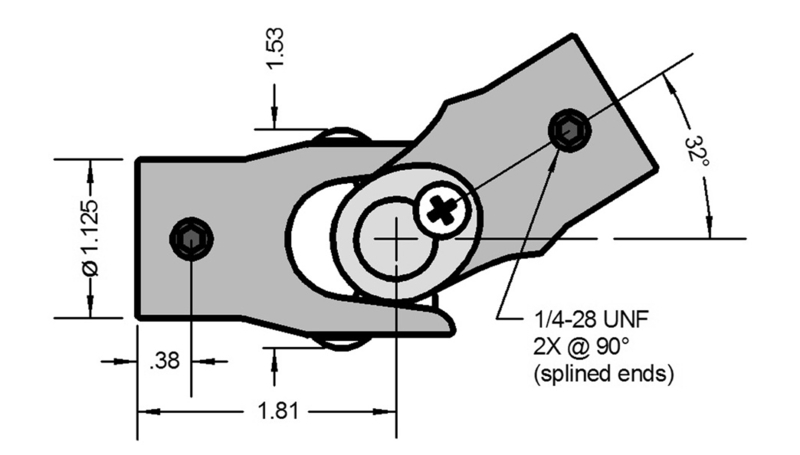
Rotational clearance circle 1.75 (44 mm) diameter
Maximum possible angular misalignment 32 degrees
Recommended operating angle <20 degrees
Torque resulting in bearing damage >250 lb/ft (>339 Nm)
Torque resulting in plastic deformation >275 lb/ft (>372 Nm)
Ultimate breaking torque >300 lb/ft (>406 Nm)
Adapts Woodward shaft to ZF rack spline used on BMW, Mercedes, Ferrari, Maserati and other European cars.
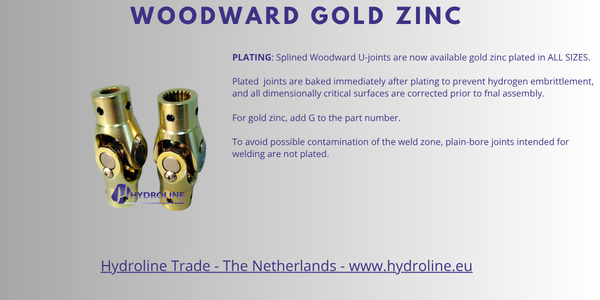
PLATING: Splined Woodward U-joints are now available gold zinc plated in ALL SIZES. Plated joints are baked immediately after plating to prevent hydrogen embrittlement, and all dimensionally critical surfaces are corrected prior to fnal assembly. For gold zinc, add G to the part number.
To avoid possible contamination of the weld zone, plain-bore joints intended for welding are not plated.
DOUBLE UNIVERSAL JOINTS: Double U-joints neatly solve problems of angular misalignment by providing a more constant rotational velocity than a single joint used at the same operating angle. These joints are available as short permanent- center units as shown, or assembled onto splined shafts at various center distances. On assembled units the Woodward “201” spline is timed with respect to the bearing axis to provide correct phasing and smooth and reliable operation.
INDUSTRIAL APPLICATIONS: Woodward can manufacture long or short runs for industrial uses such as machine tools, printing presses and assembly and packaging equipment.
MILITARY APPLICATIONS: As part of the defense procurement chain, Woodward supplies steering u-joints for combat vehicles in current production, as well as prototypes.
CUSTOM U-JOINTS: We can produce one-off splines for rare auto restorations, vintage race cars and retrofts. Alternatively, joints can be supplied unassembled for machining of special profles by the customer via slotting or EDM
OPERATING ANGLE: Although the ears of the joint are contoured to prevent it from jamming, it will not operate beyond a 32 degree angle. Any universal joint will transmit rotary motion at constant velocity when straight, but when rotating through an angle it will develop a twice-per-revolution acceleration/ deceleration cycle whose amplitude increases with the angle. To avoid variable velocity effects in the steering we strongly recommend that the total angular misalignment between steering column and pinion not exceed 20 degrees. Smoothness of operation can be further improved by subdividing the angle between two joints.
SPLINE IDENTIFICATION: The diameter shown after the three-digit identifying code is the nominal outside diameter of the male spline the u-joint is intended to fit, in decimal inches, and in millimeters where the profile was originally a metric design.
In production, a spline is measured over wires of specified diameter which fit into the vees. Since it’s seldom practical to do this in the field, we suggest you simply measure over the crests of the teeth. That measurement will usually correspond closely enough to one of the listed diameters to identify it.
Keep in mind that splines fit on the flanks of the teeth, not the crests. Like screw threads, the crests of spline teeth can be truncated without affecting the fit, so an actual measurement of any of these examples might well be .015 (0.5mm) under the nominal sizes shown here. To aid identification, the vehicle origins of the various automotive splines are also listed below where known.
The “number of spline teeth” refers to the number of equally spaced divisions of the circle, whether or not they are used in the spline pattern. Flats or interruptions are ignored (e.g., a shaft with 36 teeth, 6 of which are missing, is NOT a 30-tooth spline). If interruptions make it impossible to get a reliable count all the way around the shaft, count halfway around and double it.