Woodward Steering Universal Joints, Couplers and Splined Shafts
WOODWARD Needle Bearing U-Joints Since 1989, Woodward steering universal joints have been the preferred choice of race car builders everywhere, and have won every major race and series championship in North America many times over, including the NASCAR championship.
PLEASE DOWNLOAD OUR FULL CATALOG HERE.
Woodward pioneered the use of caged needle rollers with a slight preload to create a joint without backlash and with noticeably lower reversing inertia than conventional automotive designs. That means enhanced sensitivity at the steering wheel, and makes even the smallest steering input more effective—whether on a superspeedway at 200MPH or sideways on a dirt bull ring.
ORDER U-JOINTS FROM OUR EU STOCK
BELOW THIS PAGE.
PLATING: Splined Woodward U-joints are now available gold zinc plated in ALL SIZES.
Plated joints are baked immediately after plating to prevent hydrogen embrittlement, and all dimensionally critical surfaces are corrected prior to final assembly. For gold zinc, add G to the part number. To avoid possible contamination of the weld zone, plain-bore joints intended for welding are not plated.
DOUBLE UNIVERSAL JOINTS: Double U-joints neatly solve problems of angular misalignment by providing a more constant rotational velocity than a single joint used at the same operating angle. These joints are available as short permanentcenter units as shown, or assembled onto splined shafts at various center distances. On assembled units the Woodward “201” spline is timed with respect to the bearing axis to provide correct phasing and smooth and reliable operation.
INDUSTRIAL APPLICATIONS: Woodward can manufacture long or short runs for industrial uses such as machine tools, printing presses and assembly and packaging equipment.
MILITARY APPLICATIONS: As part of the defense procurement chain, Woodward supplies steering u-joints for combat vehicles in current production, as well as prototypes.
CUSTOM U-JOINTS: We can produce one-off splines for rare auto restorations, vintage race cars and retrofits. Alternatively, joints can be supplied unassembled for machining of special profiles by the customer. shown: UAD1-201201
The bearing trunnion used in these u-joints is a single piece of hardened chromevanadium tool steel. The grease seals are high-durometer fluorocarbon o-rings in compression against the end surfaces of the needle bearing cups. These seals will resist sustained ovenlevel heat and will retain the bearing grease under severe conditions, including welding. Other design details include stainless steel truss-head screws overlapping the bearing cups, and a pair of fine-thread knurled set screws located at 90o , for highly positive and reliable retention on a splined shaft or steering gear. Please note that the intended application of these u-joints and couplers is automobile racing, where low frictional resistance and low mass are the primary goals. Their dimensions are Woodward standards, shown in the drawing on the following page. Except for the spline sizes, which fit steering racks and gearboxes adapted from OEM automobiles, they do not conform to any automotive manufacturer’s dimensions and are not OEM replacement parts.
Mechanical Specifcations
Weight 310g (smaller hole=heavier part; larger hole=lighter part)
Rotational clearance circle 1.75 (44 mm) diameter
Maximum possible angular misalignment 32 degrees
Recommended operating angle <20 degrees
Torque resulting in bearing damage >250 lb/ft (>339 Nm)
Torque resulting in plastic deformation >275 lb/ft (>372 Nm)
Ultimate breaking torque >300 lb/ft (>406 Nm)
OPERATING ANGLE: Although the ears of the joint are contoured to prevent it from jamming, it will not operate beyond a 32 degree angle. Any universal joint will transmit rotary motion at constant velocity when straight, but when rotating through an angle it will develop a twice-per-revolution acceleration/ deceleration cycle whose amplitude increases with the angle. To avoid variable velocity effects in the steering we strongly recommend that the total angular misalignment between steering column and pinion not exceed 20 degrees. Smoothness of operation can be further improved by subdividing the angle between two joints.
SPLINE IDENTIFICATION: The diameter shown after the three-digit identifying code is the nominal outside diameter of the male spline the u-joint is intended to fit, in decimal inches, and in millimeters where the profile was originally a metric design.
In production, a spline is measured over wires of specified diameter which fit into the vees. Since it’s seldom practical to do this in the field, we suggest you simply measure over the crests of the teeth. That measurement will usually correspond closely enough to one of the listed diameters to identify it.
Keep in mind that splines fit on the flanks of the teeth, not the crests. Like screw threads, the crests of spline teeth can be truncated without affecting the fit, so an actual measurement of any of these examples might well be .015 (0.5mm) under the nominal sizes shown here. To aid identification, the vehicle origins of the various automotive splines are also listed below where known.
The “number of spline teeth” refers to the number of equally spaced divisions of the circle, whether or not they are used in the spline pattern. Flats or interruptions are ignored (e.g., a shaft with 36 teeth, 6 of which are missing, is NOT a 30-tooth spline). If interruptions make it impossible to get a reliable count all the way around the shaft, count halfway around and double it.
 | 201 .750 diameter; 20 teeth Used on all Woodward products since 1992; fits Woodward integral power racks, Woodward remote power racks, Woodward servos, and Woodward |
 | 101 .750 diameter; 48 teeth Fits most US stock-car racks past and present (Sweet, Appleton, Speedway, SWS, Quick-trac, Wilwood, Coleman, BRT, RCP, and pre-1992 Woodward) and the output end of inline Sweet servos. Originally a British standard used on MG and Jaguar racks and Austin-Healey steering shaft, among others. Note: Over the years this profile has been applied to many products without reference to the original dimensional standard; a proper fit cannot be guaranteed on parts made by companies no longer in business. |
 | 102 .735 diameter; 36 teeth Fits Mustang power rack and its clones, old manual Chevy and Ford box, Dodge truck power steering box, and most steering quickeners. Note: This is an automotive industry profile whose production tolerances varied during the half century it |
 | 103 .720 diameter; 30 teeth Introduced on 1980s GM power steering boxes and racks. |
 | 104 .820 diameter; 36 teeth Used on older GM power steering (700 series boxes) and the |
 | 105 .620 diameter; 36 teeth OEM Chevrolet Vega steering box (NOTE: may not fit “5/8-36” aftermarket copies of the Vega box). |
 | 106 .565 diameter; 26 teeth Fits Ford Pinto manual rack and pinion and most aftermarket copies. |
| 107 .625 diameter; 36 teeth Made specifically for the Stiletto (Chassis Shop) manual rack. A special profile; not an automotive standard, and NOT for Vega steering boxes. |
 | 108 .688/17,5 mm diameter; 34 of 36 teeth) Fits Toyota truck power steering with one filled spline for orientation, also other 17,5 x 36 splined shafts. |
 | 109 .750 diameter with two fats (“double D” shape) Fits Ford style DD shaft and street-rod aftermarket DD shafting measuring .550 across the fats. Does NOT ft the smaller 17 mm GM DD shaft. |
 | 110 .563 diameter; 36 teeth Fits Titan, Jack Knight and Miller racks, Ariel Atom steering shaft, also some dragster steering. |
111 .625/16 mm diameter; 23 of 36 teeth Originally made to ft the Australian TRW power | |
112 .590/15 mm diameter; 29 teeth Fits Honda rack and pinion and steering column and some aftermarket midget racks. | |
113 .570/14,5 mm diameter; 28 teeth Fits Datsun 240/260/280Z. The other end of this | |
114 .669/17 mm diameter; 36 teeth Fits Mitsubishi Starion, Chrysler Conquest and EPAS electric steering columns. | |
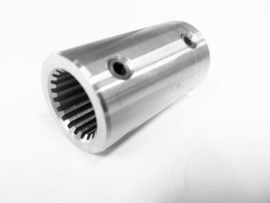
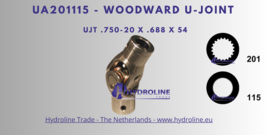
115 .688/17,5 mm diameter; 54 teeth Fits ZF steering rack and splined shafts used on many European cars such as BMW, Mercedes, Ferrari, Maserati. NOTE: On some recent steering racks, this spline does not conform to original spec. Referring to the drawing below, although
We have resolved this confict with special tooling. The #115 U-joint as currently produced will now fit all ZF pinions old | |
116 .550/14 mm diameter; 34 teeth Fits Toyota MR2 and Corolla steering rack and Quaife quicker-ratio replacement gearsets. | |
Plain bore sizes for welding onto steering shafts.100 .755/753 diameter Sized for a close slip fit on 3/4 inch cold fnished TUBING. | |
 | Plain bore sizes for welding onto steering shafts.150 .625 diameter Sized for a close slip ft on 5/8 cold fnished BAR STOCK. |


Notes on welding U-joints
While it has become obvious over many years that universal joints can be welded to shafts with a high degree of reliability, some procedures are detrimental to the U-joint and must be avoided. The joints are designed with sufficient mass and length to allow a full-circumference fillet weld without disassembly. NEVER add plug or rosette welds, as the additional contraction stresses will tend to misalign the bearing axes and/or distort the bearing bores.
(1) Plug or rosette welds on universal joints are virtually guaranteed to shorten the life of the bearings from both direct heat and the distortion resulting from weld contraction in proximity to the bearing bores. Even if the bearings are removed first (very difficult to do without damaging them) this distortion will cause enough ovality and misalignment to damage both the bearings and the trunnion journals when reinstalling. In any case, the diameter and total cross section of a circumferential weld is comfortably larger than that of a tubular steering shaft, and any additional welding in the form of plugs or rosettes would be entirely superfluous.
(2) Any welding procedure which consumes enough time to discolor the ears of the U-joint should be assumed to have drawn the temper of the bearings.
This does not necessarily disqualify the TIG process, but TIG is, unfortunately, fairly slow. To avoid heat-soaking the joint when TIG welding, use a high-strength, non-cracking filler rod such as 309 stainless and keep the cross-section small. People have successfully suspended the U-joint in water while welding around the exposed end, but this is a lot of trouble for no gain. The more practical method is MIG, as a comfortably large weld can be made in a few seconds, especially using a rolling fixture to support the shaft. ER80S-D2 wire using 25%CO2 / 75%Ar shielding gas will give excellent results for both strength and appearance.
Phasing and clocking welded U-joints
Phasing or “clocking” of universal joints for smooth operation is especially critical when welding U-joints directly to the shaft, since it will be impossible to reposition them once you’ve done it. Assuming all sections of the steering shaft lie approximately in the same plane so that the only misalignment is angular (the most common condition), any back-to-back pair should be aligned like the ends of a driveshaft, as in the illustration below.
Please study it closely; the difference is not obvious unless you are looking for it. The greater the angular misalignment of the steering shaft, the more critical the phasing of the U-joints. For reference, most stock car steering layouts will tolerate joints 20 degrees out of phase, but 45 degrees out will cause a noticeable change in rotational velocity–the steering will actually speed up and slow down during half a turn of the steering wheel.
Shafts with both angular and parallel misalignment may require special U-joint phasing which can only be found by trial and error. In the case of weld-on U-joints, this can be done by temporarily holding one of the joints onto the shaft or tube with a small tack weld, and welding it permanently in place only after you have determined its optimal position. The obvious disadvantage of welding U-joints directly to the shaft or tube is, of course, that once you’ve welded them they cannot be removed without resorting to a torch, saw, or angle grinder.

Correctly phased U-joints vs. 90 degrees out of phase.
Using weld-in splined stubs
Welding a splined stub into the steering tube is no more work than welding a U-joint to it, and by confining the welding to the tube, potential heat damage to the U-joint bearings is eliminated. A full-penetration circumferential weld of the stub to the tube will transmit steering torque as effectively as the tube itself, and is not difficult.
 |
| |
| .750-20 SPLINE WELD-IN STUB | ||
| For 3/4 OD x .120 wall : ST201A | ||
| For 3/4 OD x .065 wall : ST201B | ||
| .660 diameter pilot : ST201C | ||
| .750 diameter pilot : ST201X | ||
| .875 diameter pilot : ST201GM |

Weld-in stubs contain no moving parts and are virtually immune to damage other than weld spatter. And, unlike a splined piece of tubing they are solid and cannot be crushed by the set screws of the U-joints. The relatively low extra cost of stubs and splined joints is almost insignificant compared with the time and effort which must otherwise be invested in directly welding U-joints to shafts, removing welded U-joints with a torch or hand grinder, or trying to modify a steering shaft whose joints have been welded.
Please note that we manuacture spline stubs only in the .750-20 (201) profile, which is universally used on our products. This spline develops a more positive grip when locked with set screws than any OEM automotive spline or serration.
In Woodward U-joints the 201 spline is timed with respect to the bearing cross axis, to ensure that U-joints at opposite ends of a 201 splined shaft can always be installed correctly phased.
Prior to tacking the second stub, install a U-joint on it so you can visually orient it parallel to the U-joint at the other end of the shaft, as shown on the previous page and at the bottom of this page.
Welding technique for stubs
With a weld-in stub, plug or rosette welds can be added if desired. If so, use two; these should be as directly opposite each other as possible to equalize the inevitable distortion. The pilot of the splined stub is made a few thousandths oversize to ensure a tight fit in the expected ID of a .120 wall tube. File the pilot if necessary until it fits the tube snugly. A heavy driven fit is unnecessary and will restrain the weld joint. Leave a 1/8” gap at the root of the weld to ensure penetration. For the circumferential weld, a couple of hot MIG passes (use a rolling fixture if you can) will get the job done before any significant distortion can set in. The recommended filler wire is ER80S-D2 with C-25 gas (Ar75%/CO2 25%), available from welding suppliers worldwide. ER80S-D2 wire is also available in 36” cut lengths for TIG welding. Although a steering shaft is not a high-speed rotating assembly, straightness is still a practical goal. Keep in mind that TIG is relatively slow and that the slower the welding process, the more your finished job is likely to deviate from straight. |  |
| |
A welded intermediate shaft versus a solid splined shaft
Below (at top) is an example of 3/4 x .120 wall tubing with splined stubs welded into the ends. Although it is somewhat longer than the solid shaft (at bottom) it weighs slightly less because it is hollow except at the ends. Obviously, the longer the shaft the greater the weight saving.

Unless the lower weight of the tubular portion is of sufficient importance to justify the labor of fabrication, a one-piece splined shaft will be more convenient—particularly when the required shaft is fairly short, as is generally the case with the conversion of a modern automobile (that is, one originally manufactured with rack and pinion steering) into a race car or drift car.
Splined shafts are available from stock up to 16 inches long, with one end premachined with a locking groove 1/2 inch (12.7mm) from the end to accept the U-joint set screws. The other end is left blank for cutting to length (part numbers for this product are UADS-X-6 through UADS-X-16 and are listed on page 14).
Once you have established the finished length, the groove can be turned in a lathe, or, in a pinch, notches can be handground to accept the screws. Tightening the set screws will mark the location for the notches.
Reminder: Since the 201 spline is timed with respect to the bearing axes, U-joints at opposite ends of the solid splined shaft will automatically be aligned.
When welding stubs into tubing, ensure parallel alignment by installing a U-joint at each end and squaring the U-joints against a straightedge or surface plate prior to tacking.
Simplified U-joint Part Numbers
The new six-digit numbers are made up of the spline codes for each end.
The numerically higher code appears first, e.g. UA201109, UA109102, UA110100 etc. In addition to the common ones shown on the following pages, any combination of ends can be specified by composing an appropriate part number as above. All joints with splines at both ends (or bores other than the standard diameters) are priced the same; all joints with splines at one end are priced the same, etc.